Reselling News
Reselling News: Poshmark Stops Paying the $50 Hazmat Fee October 19, and Mercari Narrows Arbitration
Poshmark stops covering the USPS $50 hazmat fee on October 19, so a reused beauty box becomes your bill, and Mercari rewrites arbitration November 5.
Free packaging has quietly been one of the better margins in this business. Twelve days from now, a Poshmark seller who grabs the wrong free box pays fifty dollars for it.
Poshmark stops absorbing the $50 USPS hazmat fee on October 19
USPS began charging a $50 hazmat noncompliance fee on July 12, 2026 for packages that carry hazardous material markings or are not shipped under its hazmat rules. Poshmark covered the entire charge through July 31, then covered $45 of it and passed $5 to the seller beginning August 1. Poshmark's October 5 update ends the arrangement: starting October 19, 2026, the seller is responsible for the full $50 if USPS flags the package. Value Added Resource covered the change on October 6.
The part that catches resellers is that the fee is not really about what you put in the box. It is about what is printed on the outside. Poshmark names the most common cause directly, which is reusing packaging that still carries old hazmat labels or markings, and it tells sellers to look for the Limited Quantity diamond that shows up on beauty, aerosol and cleaning supply cartons. A folded hoodie inside one of those boxes is still a flagged parcel, because the carrier reads the label rather than the contents. Poshmark also points electronics sellers back to its shipping guidelines, which is the lithium battery side of the same rule.
Your move this week, not on the eighteenth. Go through the box pile and pull anything that arrived from a salon, beauty, automotive or cleaning supply order. Retire those, or cover every marking so completely that nothing shows through. A quick scribble over a diamond that is still legible is not coverage. If you are not sure what a marking means, that box is worth less than the risk, because $50 wipes out the margin on roughly two average closet sales.
Mercari narrows what you can take to court on November 5
Mercari notified users on October 6 that Section 22 of its US Terms of Service, "Legal Disputes and Use of Arbitration," changes on November 5, as Value Added Resource reported.
Two things move, and they move in opposite directions. On your side, requests for public injunctive relief or provisional relief, meaning things like a temporary restraining order or a preliminary injunction, come out of arbitration and can be filed in court. If the same case also asks for damages or restitution, those claims stay in arbitration even when they rest on the same facts. On Mercari's side, a new list of claims the company brings is carved out of mandatory arbitration entirely, covering trade secrets, patent, copyright, trademark and injunctive relief. No equivalent exception existed before.
Existing users are not getting a fresh opt-out window. The opt-out remains open only to new users, by written notice in the mail within 30 days of first accepting the terms.
There is nothing to file here, but it is worth knowing the shape of it. If a payout hold or an account closure ever goes badly on Mercari, arbitration is still the lane for anything that asks for money back. Continuing to sell after November 5 is how you accept the new version.
The takeaway
Both stories are a platform handing something back. Poshmark carried a USPS fee for three months and has decided to stop carrying it. Mercari is trimming a broad arbitration clause, mostly in its own favor. Neither one appears as a line in your sales dashboard, and both take effect on a date somebody else chose.
The maintenance that prevents this kind of surprise is unglamorous and cheap. One pass through the packing supplies every quarter, and one actual read of any terms email before it gets archived. Building that rhythm into a selling week, instead of reacting after the charge lands, is the sort of thing members work on in The Income Lab.
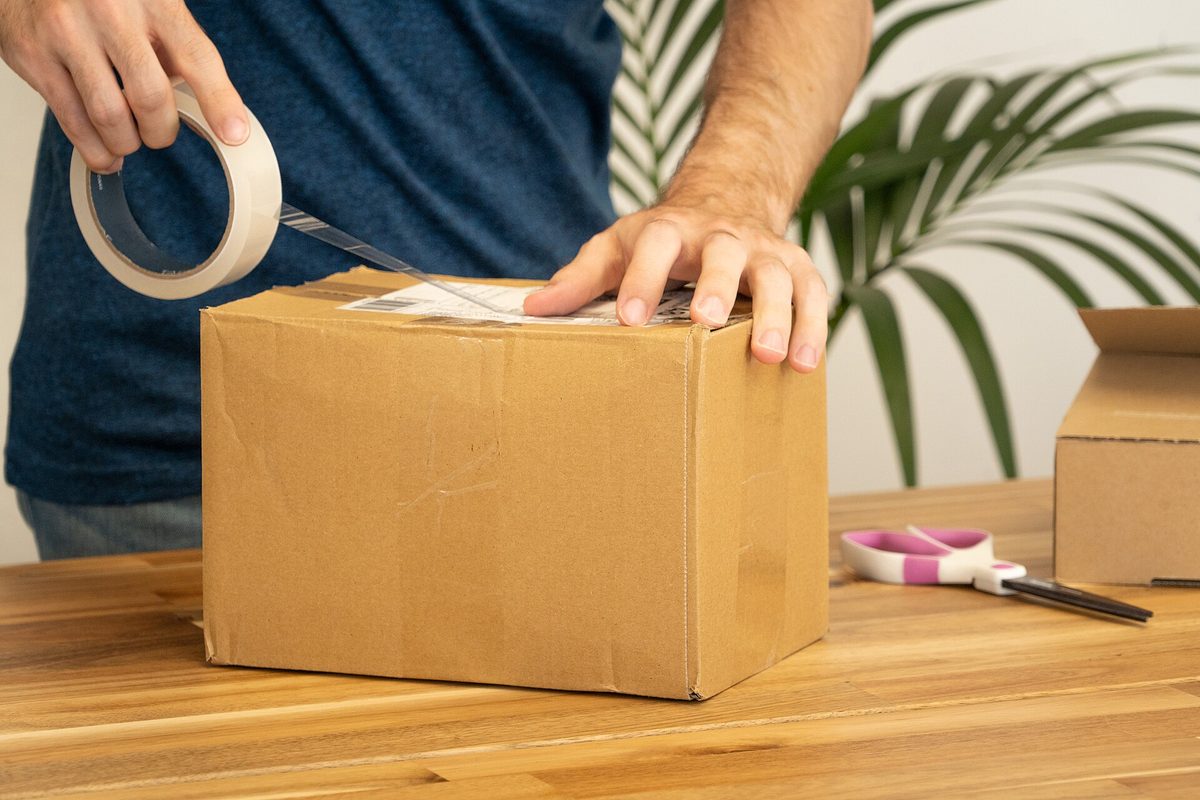
Hero image: a shipping label being taped onto a used cardboard box, photo by Meanwell Packaging, CC BY 2.0 via Wikimedia Commons.