Reselling News
Reselling News: Mercari Raises Shipping Rates October 19 and Whatnot Cuts Commissions for Volume Sellers
Mercari prepaid label rates rise October 19 and some trading cards ship free, while Whatnot moves to volume based commissions starting September 21.
Both of yesterday's announcements came from platforms that are not eBay, and both of them change a number you are already paying. One raises what a label costs. The other changes how a fee is calculated, which matters more than the percentage attached to it.
Mercari label prices move on October 19
Mercari posted the change on September 17: new prepaid label rates take effect October 19 and apply to all new and existing listings using buyer-paid or seller-paid Mercari Standard labels. There is no grandfather window for listings that are already up.
It is not a flat increase across the board. Value Added Resource went through the new rate sheet and found the UPS and FedEx economy option for packages up to 5 pounds moving off its single $7.97 price to weight-based pricing that tops out at $9.39. Some heavier UPS Ground and FedEx Home bands climb more than 50 percent. USPS Ground Advantage goes both directions depending on weight, and a few Priority Mail and Media Mail prices actually come down. Mercari points at carrier costs and says its labels still average 53 percent below retail with up to $200 of shipping protection attached.
Your move: pull up the items in your Mercari closet that sit in the 3 to 5 pound range and price a label on each one after October 19 before you accept anything. The bulky, cheap, heavy item is where this lands hardest, and that is exactly the kind of listing that was already thin. If a $22 sweatshirt goes from a $7.97 label to $9.39, the increase is not the problem. The problem is that it was a $6 profit before.
Free envelopes for single cards, through January 4
The same announcement carried a real discount in the other direction. Mercari's shipping promotion page lists free First-Class Envelope labels for qualifying trading cards and paper collectibles at 1 ounce or under, and 49 cents up to 3 ounces, both running through January 4, 2027. The envelope has to meet postal envelope dimensions, 5 to 11 1/2 inches long and 3 1/2 to 6 1/8 inches wide, a quarter inch thick, with no lumps.
For comparison, Value Added Resource puts eBay's equivalent envelope labels at 78 cents, $1.07 and $1.36 for the same three weights. On single cards that is most of the margin.
Your move: if you have been sitting on a box of commons and singles that were never worth the postage, this is the window where the postage stops being the reason. Existing listings get opted in starting September 30, but a listing you create now qualifies immediately.
Whatnot ties your commission to your volume
Whatnot moves existing sellers to a volume-based commission structure on September 21, with new sellers following the week of September 28, according to Value Added Resource's breakdown. Your sales over each four-week period set the rate you pay for the next four weeks. Below $15,000 in four weeks, the standard US commission stays at 8 percent for most categories, with coins at 4 percent. The reductions start above that line and go as low as 6.5 percent on sports and trading cards and 4 percent on general categories at the very top, plus 2.9 percent and 30 cents of payment processing on every order either way.
Read that first number carefully, because for most people nothing changed. If you are not clearing $15,000 in four weeks on Whatnot, your rate today is the rate you had last month.
What is worth knowing is the thing underneath the percentage. Whatnot charges commission on the item price only. eBay charges its Live fee on the full order, shipping and sales tax included, per its Live selling fee page. On a $10 item with a $4.99 label and 85 cents of tax, Whatnot's 8 percent is 80 cents and eBay's 6 percent is 95 cents. The lower headline rate is the more expensive one, and it gets worse as shipping gets heavier relative to the item.
The takeaway
Two platforms, one lesson. The fee you can quote from memory is rarely the fee you actually paid, because the rate is only half of it. The other half is what the rate is multiplied by, and that is the part nobody announces in a headline.
Sitting down once a quarter and recalculating your real cost per sale on every platform you use is not glamorous work, and it is the work that decides whether a busy month was also a profitable one. Members walk through that calculation together inside The Income Lab.
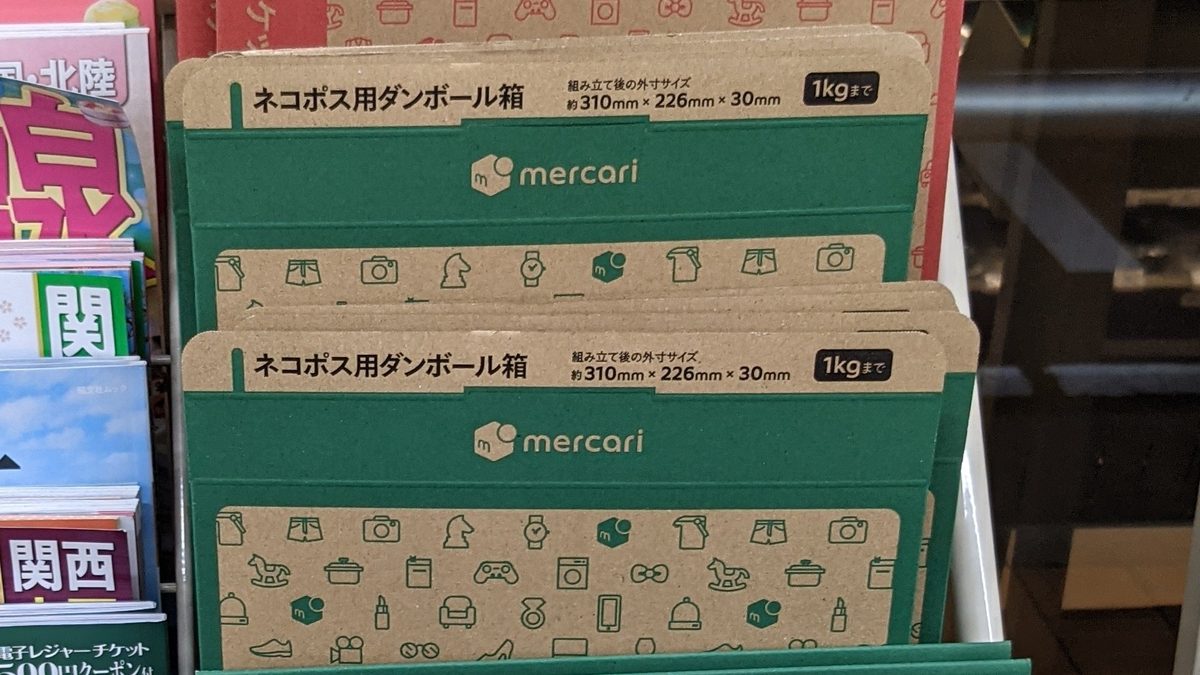
Hero image: Mercari shipping boxes at a convenience store in Daito, Osaka, photographed October 7, 2021 by Mr.ちゅらさん, CC BY-SA 4.0 via Wikimedia Commons.